

04 November 2005
Japanese media's role in supporting atrocities of WW2
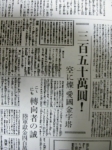
60 years have passed after Japan’s surrender in World War II, the citizens of Japan are able to speak about how much pain and suffering that they experienced as a result of the war, yet we are unable to discuss how much pain and suffering that Japan caused the citizens of other nations. To discuss such things one runs the risk of being labeled masochistic. Those in mass media willing to report upon the country’s responsibility for the atrocities that occurred during the war are also few and far between. Why do they not wish to cover such stories? One might reason that this is because the media reflects public opinion, but this is not the entire explanation. Rather it is also because the media itself bears a portion of blame.
The photo shows an article in the August 5, 1937 edition of the Asashi Newspaper.The headline reads, “3.5 Million Yen! A Glorious Monument to Patriotism”. The article contains a report on the collection of 3.5 million yen in donations and introduces some of the donors following the Asahi Newspaper’s collection of donations for the production of military aircraft. Even a mother and her child in elementary school are featured among the donors. However, the reality is that the military aircraft produced from these donations was flown to China and used to bomb such cities as Chongqing resulting in the slaughter of innocent civilians. Many people would probably be surprised to hear that the Asahi Newspaper collected donations for production of military aircraft. Considering that the newspaper is known for being a large liberal media outlet which often covers Japan’s accountability for war crimes such as the issue with so-called “comfort women” and the Nan king Massacre. The Asahi Newspaper may now even seem pacifist with its recent critical position towards the Japanese Self Defense Forces participation in Iraq, but this was not the case just prior to World War II. In fact, it may be more accurate to say that this was not the case for the period between the Manchurian Incident and the end of the war. Prior to the Manchurian Incident, which thrust Japan into the messy quagmire of the 15 year war to follow, the Asahi Newspaper objected to the dispatch of troops to Siberia during the Taisho Period (1911-1926) and further took the position of moderates who were in favor of a peaceful resolution without the use of military force to protect Japan’s interests in Manchuria.
Why then did this position change? It is generally understood that this change was due to the boycotts that occurred after the outbreak of the Manchurian incident in 1931. As a public weary of the economic recession leaned towards military fervor, Asahi found that it’s stance contrary to other media and not in sync with military views resulted in a drop in its sales. After this, the Asahi Newspaper editorial policy changed drastically.
Prior to the war, it is generally said that newspapers, magazines, and other media could not criticize the military because they were subject to intense scrutiny by authorities and laws limited their freedom of speech. However, this was not the only reason. Mass media of this era not only failed to criticize, it became a backer in a sense fanning the flames of war. It chose to support the war in an effort to increase circulation and sales. In other words, it did so in tune with the public opinion of the time which was in favor of war. This same phenomenon is at work today. Great example is US media's reports on wars in Afghanistan and Iraq.
The Frankfurt School, established by Jewish Scholars who defected from Nazi Germany, is critical of mass media which takes this position. It says that the press and mass media should above all take a neutral and impartial position and should not curry favor with emotional public opinion. It is thought that the spread of Nazism in Nazi Germany was due to the bolster support provided by mass media. At that time it appeared that the papers’ sales grew and stimulated national opinion, but in fact mass media lost sight of the all important truth and dragged society in an utterly inane direction Germany, a defeated nation like Japan, chose to abolish all of the newspapers which bolstered the Nazi regime. Yet in Japan, the mass media of the prewar period survived. Moreover, it has yet to apologize to the public for the role that it played in World War II, and to this day the press club system symbolic of the cozy relationship between mass media and government officials still thrives. In fact, this may be why none of the Japanese newspapers are willing to own up to the past. It is for this reason that we, along with mass media, are unable to fully own up to our accountability and the circumstances of Japan’s defeat in the war.
On this, the sixtieth year after the end of the war, shouldn’t the media take this chance to recognize its past role in the tragedies of World War II to and apologize to the Japanese public? Moreover, shouldn’t it use this as an opportunity to apologize to the citizens of all of the countries in Asia which suffered as a result of invasions by Japan? In addition, it is imperative that we, as the passive readers and the consumers of mass media, use this opportunity to reflect on history and reexamine ourselves. We are now in the age of the internet in which media is not just limited to newspaper, television, and radio. It is time to broaden our intellect to fight back against the prevailing mass media that contorts the truth to cater to the masses. Furthermore, it is essential that we endeavor to promote the advancement of media that no matter the circumstances always meets the truth head on.
21:10 Posted in Media | Permalink | Comments (1) | Tags: political issues, history, Japan
20 October 2005
Fucking Prime Minister Visits War Criminals' Shrine
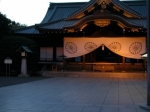
Prime Minister Koizumi is idiot.
He is just making our country worse. He visited the controversial shrine which honours war criminals responsible for Japan's invasion of China. The shrine insists the war was just and liberated Asians from western imperialism. That is not true. The Japanese army killed many, many Asian civilians there.
Asian victims and their familes never forget that.
Half of Japanese citizens including me oppose his visit to the shrine. business people, too.
Prime Minister says it was private visit. Private? He went there with press. Since he is a PM, he can never be a private person.
For Americans, it should be great news, as Japan's relationship with China got worse, US government can get more dealing cards when it comes to negotiate with Japan or China. For China and Japan, it is just a bad card.
The top picture is the sanctury of the shrine.
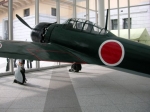
The shrine has the museum that shows how bravely Japanese army fought in the war. The war Japan failed.
The below is picture of famous zero-sen air-fighter.
23 April 2005
"Extreme Measures (1996)" reminded me of Unit 731
I saw this movie on HBO channel at the hotel in Beijing.
The movie was with Chinese subtitle. The movie reminded me of one horrific history between China and Japan. That was biological and chemical experiments on real human bodies done by Japanese army's special unit called Unit 731. Maybe because I was in Beijing and anti-Japan riot was about to begin, I got into this story very seriously.
The story is New York's ER doctor named Guy (Hue Grant) met with a strange patient. After the patient died, he searches for the mystery of the patient's death. Then he discovered the secret experiments going on that uses homeless people's bodies. The project aims to find new way to create nerve for disabled people. So the motive was not to create biological and chemical weapons. But both of the experiments use human bodies without examinees' consent.
I used to meet with ex-Unit 731 soldier. His name was Mr. SHINOZUKA Shiro. He made a speech of his experience. He said he has been trained to be militaristic man that can give up humanistic mind. He and his collegues called the examinees "Log." The people called "Log" included Koreans, Chinese. After the war, he was captured but by Chinese government's generous policy he was released. He realised how horrible what he has done was.
Strangely ex-Unit 731 soldiers were never prosecuted even by US occupational force.
Why?
You can find a reason for that by seeing the last scene of the movie.
In the last part, Guy met with wife of the leader of the experiment. The leader died by gun shot of the quarrel between Guy and the leader's friends. She says to Guy that her husband's measure was wrong but the motive was right. She gave her late husband's corrected data of the experiment. Guy received that.
Japanese people including me should know such thing has happened in China. This week Tokyo high court rejected the compensation demand by victims and ex-victims of Nanjin atrocities and Unit 731 experiments.
I feel very sad these days.
17:50 Posted in Film, Science | Permalink | Comments (0) | Tags: political issues, history
15 April 2005
Why Chinese are angry with Japanese!
I've heard from one Japanese student living in Shanghai that those who participated in the demonstration march were small portion of Chinese. China has a big population. Even 20,000 demonstrators is not big scale.
It is said Chinese government is using anti-Japan sentiment to distract people's attention from failures of the government's economic policy that created wider gap between the rich and the poor.
But yes there are problems on our side which provoked such riots.
One is Prime Minister Koizumi's visit to the Yasukuni Shrine that enshrined A-class war criminals of WWII. A-class war criminals were political leaders of that time including PM Tojo who ordered to attack Pearl Harbor. They are the invaders for Chinese but heroes or victims for Japanese right wingers. Koizumi and ruling party is backed up by such right wingers. The right wingers claim Tokyo tribunal that convicted A-class war criminals was unfair because the judges there were all from victors' countries. Also they claim Japan's war in China and against US was just war.
The other reason is related to the right wingers' interpretation of the history between China and Japan. They believe Japan is always right. They believe we should deny any unfavourble facts in our history such as atrocities in Nanjing, 1937. They've been campaigning to delete such facts from textbooks with politicians.
As a result, this year's newly published textbooks reduced such facts telling from previous edition.
This is outrageous. The right wingers believe it is good for our country. No. They are wrong. They are just embrassing our country.
As for A-class war criminals, I agree with their claim of unfairness of the court at that time, but we have to be aware of their responsibilities of the wrong corrupt war.
The below picture is taken in Nanjing (Nanking) last September. I was at the grave of victims of Nanking Masscre. Hundreds of thousands of innocent people were brutally murdered by Japanese army.
I do not support the riots but I understand the anger of Chinese people.


19:30 Posted in China, Politics | Permalink | Comments (0) | Tags: Shanghai, political issues, history, International Relations