20 September 2009
Japanese military's Anthem
Please listen to the music. It is a good one.
Umi Yukaba (If I go away to sea).
I like it. I can feel the souls of dead soldiers belonging to Japanese army.
The song is played with translated lyrics (English and Russian).
The song is not played in public any more because it souds encouraging military men to die.
But it had been considered Japanese imperial army's anthem and second national anthem until the end of second world war.
The below one is without lyric subtitle but with adequate images for the song.
I never support war actions for invasion but I like the song anyway.
22:13 Posted in Music | Permalink | Comments (0) | Trackbacks (0) | Email this | Tags: history, military, war
14 September 2009
Comic Version of "Mein Kampf"
Recently controversial Manga (Comic) book was published in Japan. The comic was digest version of what is written on original thick book, "Mein Kampf (My Struggle)."
Left one is comic and right one is Japanese complete translated version.
As you know it was written by Adolf Hitler, dictator of Nazi-Germany, the book described his biography from when he was childhood until imprisonment after Munich rebel in 1923. It contains so much of Anti-semitism.
The pictures of the book reminds me of CBS Minis-Series "Hitler, The Rise of Evil." Surely the book and the drama should somewhat overlap because both are at least partially based on the same book.
In Germany publication of the book is banned. Actually the book wasn't very popular one at the time it was published.
This comic version is one of the series of classic literature including "Crime and Punishment," and "Faust."
I am recently very interested in Hitler and Nazi-Germany. How he got on the top and why such atrocities happened.
Recently Japan experienced similar phenomenon, an Air Force Chief was fired because of his provocative essay released in public which contradicts Japan's position of war responsibility and justified what Japan did to neighboring nations such as occupation and colonization.
His statement to the government's treatment was really similar "Strangely I was fired because I've made good statements for the nation."
After he left defense ministry, he became an icon among right-wing people. He published several books and made speeches all over the nation. I am sure he will run candidancy for next coming election. Strangely I, not so conservative person have been very much attracted to him since his public appearance. I bought one of his books. I went to his speeches and shook hands with him. Please read this if you want to know more about my passion for him. That is why I am feared. He has charisma and intelligence to lead people.
So that is why I am studying things about Hitler and Nazi-Germany.
I am now writing a novel which the story takes place in 1930's Germany on this blog. The theme of the novel is Nazism versus liberalism such as Bauhaus art. Please read "Bauhausler" if you are intereted.
22:40 Posted in Books, Culture, Deutschland, Japan News, Politics | Permalink | Comments (0) | Trackbacks (0) | Email this | Tags: history, nazis, racism
05 September 2009
German Film "Baader-Meinhof" A story of German Red Army
I went to the theatre in Shibuya to see the film.
I really enjoyed it. German films are enjoyable if you know history of Germany such as Nazis, Berlin Wall, and 1968 anti-imperialist movement.
So far, what I have seen are as for Nazis "Sophie Scholl," "Der Untertgang" and as for Berlin Wall, "Lives of others," and "Good-bye, Lenin."
This time I watched post-war radical movement that took place in 1968, Germany. Youngsters became so radical because they believe they could wipe out imperialism and change the world better. One female liberal journalist with two daughters joined the movement.
But the consequence was disastrous. They became terrorists, bombers and hi-jackers, later ended up with commiting suicide in prison cells.
Japan had the same movement in the same era. The consequence were very similar. These days youngsters are not interested in such radical way of movement.
Germany and Japan went through the same path since 1930's in that sense. The country was dominated by militants in pre-war era. After the war, youngsters provoked radical social movement.
Recently my interest to foreign things was shifted from the U.S. to Germany.
I went to Berlin last year. I was really impressed. I get acquainted with German people in business. I am studying German now.
Germany has a lot of things we, Japanese can learn from. One of notable things is how they dealt with war review and compensation.
Other things are local sports club, farms, and ecology policy. Germany is leading producer of solar PV in the world.
Germany succeeded reduction of CO2 emission as it scheduled following Kyoto Protocol while other nations failed.
I want to know more about this country.
Deutcheland uber alles in der Welt!
15:33 Posted in Deutschland, Film, Politics | Permalink | Comments (0) | Trackbacks (0) | Email this | Tags: history
20 August 2009
I fell in love with this guy!
See this videoclip! He is Japan's new hero. Sorry, only Japanese version.
His speech in Hiroshima. Scenes of anti-nuke group activities, and Uigurs who protest nuclear tests done by China (time code: 3:42) in the city come first.
And the people who protest and support his speech (time code: 6:34) and then scenes in the convention hall which his speech took place.
He was Japan's Airforce chief but was dismissed because of his provocative essay he released in public.
I've already introduced him in other article on this blog. Please read this.
He is passionately patriot. But his statements were too provocative.
But he and I have things in common. Both of us want to get rid of U.S. military bases from Japan to protect our sovereignty and tradition.
He even claims Japan should arm with nuclear weapons.
I've met him twice and shook hand with him. I could take a picture of him. The below is what I took at Kudankaikan hall in Tokyo, where his speech was held.
He was very polite and gentle. His speech was filled with passion.
Second time was the meeting for journalists. He has made a similar speech. I was given a opportunity to ask a question. I denounced his statement about denial of Nanking Massacre because I've met some survivors of the atrocities. But I said to him, I am for Article 9 amendment so that Japan can possess legitimate military but it was illegal to cause civilian casualties even at the time Nanking Massacre occurred. Why not we swear not to repeat the same mistake like Germany did?
His response was kind of surprise. "I've met a military official in China. They spoke so ill of what our military had done over there. I wanted to tell him, why not they spoke the same things about Britain? We are better than what Britons did. The Convention treaty was signed between the two countries. It was done. Why can't we forget about it?"
He seemed to admit the fact that the atrocity occurred. He was kind of honest and clever, I think. He just try to use this history issue to change his country's military policy. Interesting guy!
Thanks to him, I rethink about what patriotism is and what our tradition is. I became patriot and traditional.
Recently I started to wear Japanese traditional clothes including swim suit of the below. The suit became unpopular since the U.S. occupied Japan because Americans thought such Japanese tradition was barbaric. Now I am trying to recover this tradition. I am proud of wearing it and showing myself in it in public. This suit makes any man sexy and real Japanese traditional man, so called Nihon Danji. It is not only used for swimming but participating in festivals. The below is how I wear it, please enjoy watching.
22:23 Posted in Deutschland, Politics, un-USA | Permalink | Comments (0) | Trackbacks (0) | Email this | Tags: history, military, racism
01 August 2009
Why not remake "Shogun"?
As I described before on this blog, I became a free walking tour guide of East Garden of Imperial Palace. Read this article.
Last week, I met an American woman who is a college professor. I guided her to the imperial palace and explained history of pre-modern Japan and the imperial palace.
Imperial Palace was in fact, Shogun's castle before modern times. Shogun literally means "General." He was a actual ruler of Japan. A lord that takes control of all the regional lords of Japan. The emperor has been the symbol of Japan although former constitution states he was divine and above all. He never actually took authorities. The emperor was relocated to the palace in Tokyo from Kyoto after Japan's modernisation around 1860's.
I talked with her about TV mini-series "Shogun." It was aired in US and Japan 1980. The drama was based on James Clavell's book.
She told me she watched the show and read the book, too. It was reall popular show.
I wonder why someone wants to remake it as movie. Recently Japanese famous film stories were being remade by foreign film maker like "HACHI" and "47 Ronins."
Then why not remake this TV mini-series?
Can they make this long hour TV drama into 2-3 hour movie story? I think it may be possible. The film should be remade by Britain.
It is a story of British navigator cast away to Japan coast and saved by a lord who later became first leader of unified Japan in 17th century.
The British man, Miura Anjin was modeled after a real person named William Adams.
This time, I would advise the film maker to insert clearer description of homosexuality in that period. In TV mini-series, there was a scene that implied how tolerated homosexuality was in those days Japan. Now a generation passed. It should be featured more openly. Like Anjin has a sex with beautiful boy for pillowing following the advice from his interpreter, Mariko.
It was openly done that a samurai who had a wife or wives and even children had sex with boys for pleasure. They even had sex with their retainers or sworn brothers. It was very common and never considered abnormal like modern times.
Surely Shogun enjoyed gay love affair and sex not just with his 1000 wive in the castle. It is said that one of the reasons the Shogun could maintain good governance of Japan for centuries was he tolerated sexual life style of people. Japan was originally free-sex society unlike some Christian societies where sexual regulation was a key to maintain order of a society.
I am excited to see the remake version of "Shogun" and gay scenes in it.
23:22 Posted in Britain, Culture, Film | Permalink | Comments (0) | Trackbacks (0) | Email this | Tags: history, samurai, gay
21 June 2009
"Auld Lang Syne" is very nice song
This was in fact Scottish folk song.
The song for rememberance and friendship. In 19th century the song was introduced to Japan and was used as martial song.
Japanese translated version "Hotaru no Hikari, The glow of a firefly" was for promotion of patriotism and imperialism.
I learned this song when I was small. Recently I enjoyed the song in the war story film "Umi-yukaba."
The story took place in early 20th century, when Japanese sailors fought against Russian fleet.
When the battle ship departed from Japanese imperial navy's port, Sasebo. This tune was played on the ship by its brass-band.
The sailors were waving their hand to the local people who were waving national flags to them.
The battleship was called "Mikasa." I have strong spritual connection with the ship.
I remember when I first visited Yokosuka to join the protest activity against deployment of USS George Washington last year.
I was invited to the ship by the souls of the sailors. At first I tried to get to the office of the activist group from the train station, but I got lost and after a while I found myself standing in front of the ship exhibited in the marine park.
The Mikasa was flagship of Japanese imperial Navy in early 20th century. During Russo-Japan war (1904-05) the ship and its fleet struck down Russian imperial navy's Baltic fleet in Sea of Japan. Japan won Russian Empire. The ship was built by British. Japan was supported by Great Britain in the war. British did not allow Baltic fleet to pass Suez Canal so that the Russian fleet had to spend more time, supply and coals to reach Japan's sea.
We owe a lot to Great Britain but unfortunately two nations fought against each other in the war later.
I recently found a good video clip for the song. The background image is scenes from a classical film "Waterloo Bridge" which Vivien Leigh, an actress who also starred in the very famous classical film "Gone with the Wind." I don't know who sang the song. I wish some day I would be able to listen to the song sang by a famous British singer, Suan Boyle.
14:36 Posted in Britain, Music | Permalink | Comments (0) | Trackbacks (0) | Email this | Tags: history, movies, navy, nuclear aircraft carrier, military
13 June 2009
Became a free walking tour guide for Imperial Palace
Today, I have become a guide for free walking tour guide for Imperial Palace in Tokyo.
Though I am not a professional guide but I speak English so I joined the volunteer activity.
It was nice. Today I and other two guides started the tour from Tokyo Station.
There were 10 people gathered at the exit. They were from Canada, Australia, Sweden and North Carolina (U.S.A).
After explaining to them history and current renovation plan of Tokyo Station, we took them to Tokyo's most famous tourist spot, Imperial Palace.
We explained to them how the castle was protected from invaders, such as surrounding mort, Stone Walls, Trap gate, and checkpoints.
We talked about middle age to modern time history of Japan as to how the country was developed into a unified nation.
It was sunny and hot day. They really seemed to enjoy the tour.
If you are living in Tokyo or have a chance to visit here, why don't you join the tour.

The tour is held every Saturday afternoon at 1PM. Gather at the Marunouchi central exit of Tokyo Station.
Straight-ahead is Imperial Palace.
See you there!!
22:16 Posted in Tokyo Life, Travel | Permalink | Comments (0) | Trackbacks (0) | Email this | Tags: tokyo, japan, history
29 March 2009
Enjoyed Bauhaus Arts
I went to the exhibition of Bauhaus art in Utsunomiya Museum of Art in Utsunomiya city, 1 and half hour train ride from Tokyo.

That was very amazing exhibition. I've learned so much about Bauhaus stuff buying books on Bauhaus history, arts, and architecture.
Bauhaus was established in 1919 in Weimar, Germany and was later relocated to Dessau and finally relocated in Berlin.
But in 1933, after Nazis took over authorities of the government, Bauhaus ended just as Weimar Republic did.
It was a symbol of modernism. The cocept was unification of art and technology. Respecting functionalism but being artistic.
There exhibited famous pipe and leather chair called "Wassily chair," which was designed to sit on comfortably. Desks, beds, lamps and other interior.

Beautiful drawings, which should have been very innovative in those days.
The reason why I am so interested in it is I am writing a short novel using history of this art school.
The title is "Bauhausler." A Japanese woman who came to Berlin to study modern art at Bauhaus school experienced turmoil between this innovative art and growing Nazism.
22:31 Posted in Culture, Deutschland, Japan News | Permalink | Comments (0) | Trackbacks (0) | Email this | Tags: history
26 March 2009
Film: Walküre (Valkyrie)
I went to see Tom Cruise's movie "Valkyrie." The film of actual event which took place in Germany during World War II.
German military officer, Colonel Stauffenberg tried to assassin German dictator, Adolf Hitler to remove Nazi Party from power and bring peace in Europe. The consequence was he failed and was executed.
I've seen German film of the story before. Then I went to Berlin and saw the memorial of his execution.
00:14 Posted in Deutschland, Film | Permalink | Comments (0) | Trackbacks (0) | Email this | Tags: history, nazis
09 March 2009
Short Novel 4: "Bauhausler" Introduction
A new novel after 4 American Hostages in Baghdad
A story of Japanese woman who experienced Bauhaus art and love romance in Berlin, early 1930's when Nazis came to power.
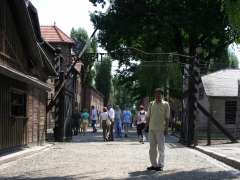
Summer 2009, Auschwitz Museum in Oswiecim, Poland
"Ladies and Gentleman. Thank you for gathering today. We are here to honor the biggest contributor to this museum in our history. Late Madam Masako Chikano."
A man spoke in Polish and English in front of tens of people, mostly journalists gathered in the conference room. The speaker is the head of the museum. Auschwitz-Birkenau, The World Heritage, death camp built by Nazi-Germany.
Late Madam Masako Chikano was called "Hotel Queen" in Japan. She died of natural causes last year. She was 98 years old when she died. She established one of Japan's most biggest hotel chain, Chikano Hotels. The chain ranges from high-class to cheap business purpose only style. But all the hotels she owned had one thing in common, every room, lobby, and some of the corridors placed interesting pipe chairs, usually called Wassily Chair. It is one of most symbolic Bauhaus furniture.

Some of the hotel buildings were designed in the way of Bauhaus concept. Modern, functional, minimumal ways.
It was one of the mysteries of the hotel queen, why she liked Bauhaus style. She was very mysterious woman.
Other mysteries are,
Although she had been known as most energetic business woman in Japan until her retired age 80, she had been single for her life. She dedicated her life to hotel business, but she was actually very beautiful woman that could attract any man. Indeed she was once married when she was 20 to 21. She never got remarried after the divorce of first marriage.
The will she left said that she wanted to donate all her fortune to the Auschwitz Museum. That may be a biggest mystery of her. What made her want to do such thing?
The speaker held the will in his hand and said,
"To begin with, we have to talk about her connection between this museum and her early life experience. This is the part rarely known about her life. She never wanted to talk about that part in her life. But that was most important part in her life as mentioned in the will. Now let us unveil one of the most important mysteries of this woman."
Berlin, Germany, October, 1932

Masako Chikano arrived in Berlin. She came to capital of Germany, Deutcheland all the way from Yokohama, Japan. First by ship, almost 1 month travel to Marseille, France via Colombo, Ceylon (Sri Lanka) and then from Marseille to Berlin by train for a few days.
She was heart broken after the divorce. Because of the divorce just a year after marriage, she was treated as embarrasment of her family, Baron Chikano. Noble which succeeded highest rank of samurai. Her father, Baron Kozo Chikano was a member of House of Lords and ran business of finance and military equipments. Her family belonged to elite class in Japan.
The reason that she got divorce was she had an affair with her husband, Yoshio's best friend Takeshi. Actually Yoshio regarded him as his sworn brother. Both of them belong to Japanese Imperial Navy. Her affair with Takeshi made him angry and kick her out. After she came back to her home, her family had to kick her out because of biggest blunder in the family's history. She dishonored her family's name. They had to hide her until the bad reputation would fade away. Her father ordered her to leave Japan for several years. She had to stay in foreign country where no one knew her.
She had good command of English and Germany since she learned those languages from childhood as part of upper class education. She chose to go to Berlin, Germany. She did not have specific reason to choose it. She just prefers learning modern art. She heard good reputation of German born modern art, Bauhaus.
Here she was in Berlin. She opened a door to her new life. She believed she could forget about all the mess.
Continued to Chapter 1.
This novel is copywrighted by this blog's manager, Masagata.
00:59 Posted in Deutschland, My novel | Permalink | Comments (0) | Trackbacks (0) | Email this | Tags: history, poland, nazis, gay, holocaust